39.9% of New Building Development Firms Close Within 5 Years, Study Shows

A new analysis of Companies House data reveals that nearly 39.9% of newly established building development and house building companies in the UK have closed within five years.

The study, conducted by GB Concrete & Pump, highlights the significant challenges facing the sector amid volatile market conditions and the risks for companies attempting to establish themselves in construction.

new build development

High Failure Rates in the Building Development Sector

The study, covering company data from January 2019 to December 2023, looked at incorporation records across key segments of the building development industry. By tracking companies that have entered administration, liquidation, or dissolution, the findings paint a clear picture of survival rates across several building sub-sectors.

Across all categories examined, a striking 41.1% of new companies have ceased operations. However, the closure rates vary significantly across different construction segments, indicating unique pressures faced within each sub-sector:

Demolition
Closure rates are highest in demolition, where 56.3% of new firms fail – making it the most volatile and capital-intensive segment.

Site Preparation
46.6% of site preparation firms have closed, reflecting high costs and operational complexity.

Construction of Commercial Buildings
45.7% of commercial construction companies have ceased trading, underlining the competitive nature of the sector.

Domestic Building Construction
43.8% of domestic building firms have closed, showing that even housing-focused businesses face significant risk.

Building Project Development
This segment shows greater resilience, with a lower closure rate of 33.9%.

The Takeaway

The recent Labour budget announcement has introduced a potential lifeline for small housebuilders, promising an additional £3bn in guarantees. However, industry experts caution that the measures may come too late for companies already struggling under economic pressures.

Commenting on the findings, our spokesperson for GB Concrete & Pump, Director Vinny Singh said: “Our analysis reveals the reality of operating within the building development and housebuilding sector. With nearly half of new companies struggling to stay open, it’s essential for newcomers to recognise the challenges and strategically plan to improve their odds of long-term success.

The high closure rate of new businesses could potentially impact the overall growth and innovation within the sector. Fewer new entrants could lead to a less dynamic and competitive market, potentially affecting the supply of new homes and commercial buildings.

Although Labour has confirmed an additional £3bn in guarantees to support small house builders, it may already be too late for firms already struggling to afloat. Not to mention, it is not yet clear how this support will be allocated.”

If you’re planning a project and want reliable concrete supply or expert advice, contact GB Concrete & Pump to discuss your requirements.

How to Lay a Patio for Beginners: The Importance of Leveling Concrete

Transforming your garden doesn’t have to be complicated. One of the most effective ways to upgrade your outdoor space is by laying a patio – creating a practical area for relaxing, entertaining, or giving children a safe place to play.

While it might seem like a job best left to professionals, laying a patio is entirely achievable for beginners. The key is good preparation and, most importantly, ensuring your concrete base is properly level.

In this blog, we’ll walk you through each stage of the process so you can get it right first time with some expert tips from our team of concrete specialists.

How To Lay A Patio – Step By Step

Step 1: Plan Your Patio

A successful patio begins with careful planning.

Think about:

  • The size and shape of your patio
  • How you’ll use the space
  • The type of slabs or paving you prefer

It’s also essential to plan for drainage. Your patio should have a slight slope (typically a fall of 1:60) running away from your house to prevent water pooling.

Step 2: Gather Tools and Materials

You’ll need the following tools and materials for the job:

  • Patio slabs or pavers
  • Sand or sub-base material (such as MOT Type 1)
  • Concrete mix
  • A spirit level
  • A trowel and spade
  • A plate compactor or tamper
  • String and pegs for marking out
  • A rubber mallet

Having everything on hand will make the job far smoother.

Step 3: Mark and Prepare the Area

  • Use string and pegs to mark the area for your patio.
  • Dig out the area to a depth of around 150-200mm (6-8 inches), allowing space for your sub-base, concrete, and slabs.
  • Clear away debris and level the ground to create a stable foundation.
measure and prepare for laying a patio

Step 4: Lay the Sub-Base

Spread around 100mm of MOT Type 1 or crushed stone across the area.

Compact it thoroughly using a plate compactor or tamper until it’s firm and level. This forms the foundation of your patio and prevents future movement or sinking.

Step 5: Mix and Pour the Concrete

The next step is preparing your concrete mix. For patios, a standard mix ratio of 1 part cement to 5 parts ballast (or sand and gravel) works well. Add water gradually until you achieve a smooth consistency.

Pour the concrete over the compacted sub-base, spreading it evenly using a trowel. Here’s where leveling becomes critical:

Why Leveling Concrete is Crucial

A perfectly level concrete base ensures:

  • Even Surface: Prevents wobbling pavers or slabs, providing a stable surface for walking and furniture.
  • Proper Drainage: Avoids water pooling, which can damage your patio over time.
  • Long-Term Durability: Minimises the risk of cracks or uneven settling, which can lead to costly repairs.

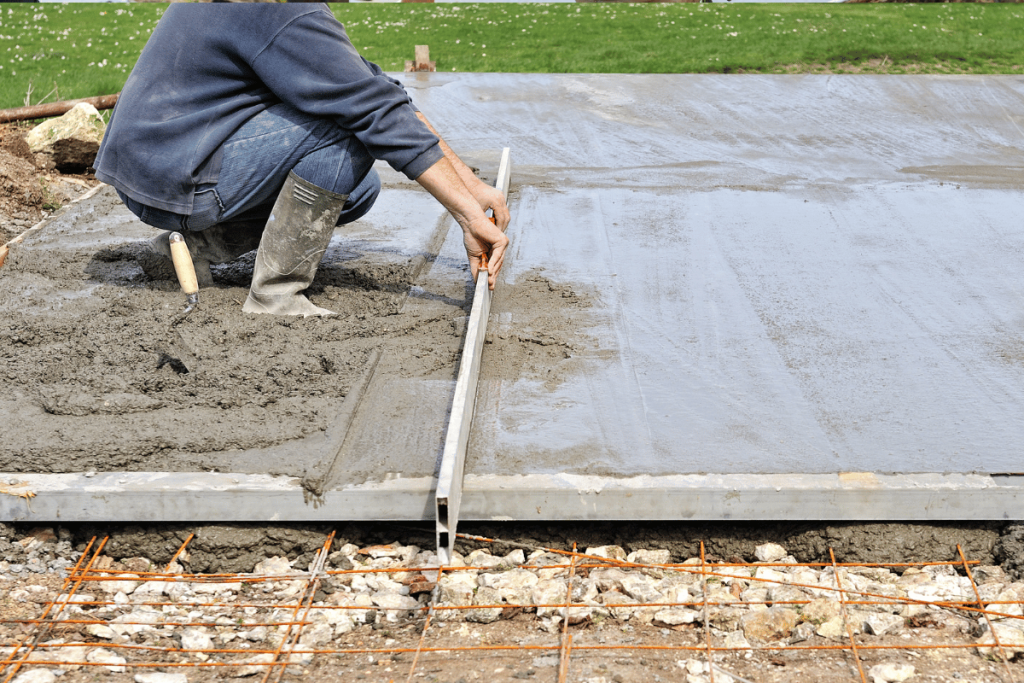
To achieve proper leveling, use a straight-edge or screed board to smooth the concrete. Check the level frequently using a spirit level to maintain consistency and the correct slope for drainage.

Step 6: Lay the Patio Slabs

Once the concrete base is level and slightly firm, start laying your patio slabs. Begin in one corner, using a rubber mallet to tap each slab into place. Maintain even spacing between slabs, using spacers if necessary.

Step 7: Fill the Joints

After laying all the slabs, fill the gaps with jointing sand or a mortar mix. Sweep the sand into the joints and compact it to ensure a secure finish.

Step 8: Finishing Touches

Once everything is in place, clean the surface of the slabs and let the patio set for at least 24-48 hours before using it.

Top Tips For Successfully Laying A Patio

  • Always wear protective gear when working with concrete
  • Double-check levels at every stage
  • Don’t rush the curing process
  • Plan your work around mild weather conditions

Need Help with Your Concrete?

If you’re unsure about mixing or pouring concrete, getting the right support can make all the difference.

GB Concrete & Pump supplies high-quality concrete and pumping services across Birmingham and the Midlands. Whether you’re tackling a DIY project or a larger job, having the right materials delivered and placed correctly helps ensure a strong, level base from the start.

If you need a helping hand, get in touch with us and see how we can help.

Choosing the Right Foundation Concrete Mix: A Guide to Strengths, Ratios, and Common Pitfalls

When it comes to constructing strong, durable foundations, selecting the appropriate concrete mix is crucial. The mix you choose will determine everything from the load-bearing capacity and stability to the longevity of the foundation which are all key factors for any structure.

At GB Concrete & Pump, we specialise in offering tailored concrete mixes to ensure your foundation is built to last. In this blog, we’ll go over some of the most common foundation concrete mix strengths, recommended ratios, and a few common mistakes to avoid.

Understanding Concrete Mix Strengths for Foundations

Concrete strength is measured in megapascals (MPa) or pounds per square inch (psi) and indicates how much load it can bear. Different projects require different strengths depending on factors such as soil type, load requirements, and environmental conditions. Here are some common strengths used for foundations:

  • C20/25 (20 MPa or 2500 psi): Suitable for light-use foundations, like small residential buildings and garden walls. C20/25 is ideal for non-load-bearing walls, patios, and similar structures.
  • C25/30 (25 MPa or 3000 psi): Often used for domestic foundations, such as those supporting single-family homes. C25/30 provides good strength and durability for average soil conditions.
  • C30/37 (30 MPa or 3700 psi): Ideal for foundations with a higher load-bearing requirement, such as multi-story homes or commercial buildings with moderate load.
  • C40/50 (40 MPa or 5000 psi): Often recommended for heavy-duty foundations, such as those required for high-rise buildings or structures on loose or challenging soil types. C40/50 offers enhanced strength and durability, making it a great choice for areas with heavy traffic or where extreme weather is common.

Choosing the right strength for your foundation depends on factors like soil type, structural load, and even local building codes. If you’re not sure which you need, get in touch with us and we can help. Similarly, if you’re not sure how much you need, use our concrete calculator to help you avoid over- or under-ordering.

mixed concrete

Concrete Mix Ratios for Different Foundations

The mix ratio of concrete refers to the proportion of cement, sand, and aggregate (gravel) used. Each of the components plays a key role in helping to achieve the desired strength and durability for the fundation.

  • C20/25 Mix (1:2:4): This is a standard ratio used for light-duty foundations and the mix typically involves 1 part cement, 2 parts sand, and 4 parts aggregate. It’s ideal for basic, low-load applications.
  • C25/30 Mix (1:1.5:3): This stronger mix has a slightly higher cement content, making it suitable for standard residential foundations. The ratio of 1 part cement, 1.5 parts sand, and 3 parts aggregate gives it greater load-bearing capacity than the C20/25 mix.
  • C30/37 Mix (1:1:2): For higher strength, a 1:1:2 ratio (cement, sand, aggregate) is used. This mix is commonly chosen for heavy-duty applications, such as foundations in multi-story buildings.
  • C40/50 Mix (1:0.75:1.5): With its higher cement content, this ratio of 1 part cement, 0.75 parts sand, and 1.5 parts aggregate offers the highest strength. It’s perfect for foundations that need to withstand substantial load or adverse conditions.

Common Mistakes When Mixing Foundation Concrete

Even with the right strength and ratio in mind, it can actually be quite easy to get it wrong. There are a lot of variables at play that can compromise the quality of your concrete foundation. Here are a few common pitfalls to watch for so that you don’t get it wrong:

1. Inadequate Curing: This is an essential stage for the concrete to reach its full strength. If you fail to keep the concrete moist during the curing process this can cause it to dry out too quickly, leading to cracks and reduced durability.

2. Incorrect Water-to-Cement Ratio: Adding too much or too little water can weaken the concrete. Excess water dilutes the mix, making it weaker, and too little water prevents proper bonding and workability. It’s important to get the perfect balance and you can do this by following the recommended water ratio closely.

3. Improper Mixing: Concrete needs to be consistently mixed to achieve the best results. Unevenly mixed concrete can lead to weak spots in the foundation, affecting its load-bearing capacity. We would always recommend to use a reliable mixer and make sure all materials are thoroughly combined.

4. Using Poor Quality Aggregate: Low-quality aggregate can impact the strength and longevity of your foundation. Always go for high-quality, well-graded aggregate to achieve the best results. At GB Concrete & Pump, we’re proud to use the highest quality aggregates on the market that produce the highest quality concrete.

5. Ignoring Environmental Factors: Cold or hot weather can impact how concrete sets. Extreme temperatures require you to make adjustments in mix, placement, or curing methods. Be sure to account for weather conditions when planning your pour.

Why GB Concrete & Pump Is Your Go-To for Foundation Concrete Mix

Choosing the right concrete mix can be a complex process, but GB Concrete & Pump is here to simplify it. We provide expert guidance and high-quality materials to ensure that your foundation is strong, durable, and fit for purpose. With our specialised concrete mixes, you can rest assured that your project will meet the highest standards. And our volumetric concrete services make sure you get exactly the right amount.

Ready to get started? Use our online concrete calculator to determine the exact mix and cost for your project in minutes! Let GB Concrete & Pump deliver the right mix, every time.

Working Out a Concrete Price per m³: A Guide from GB Concrete & Pump

When you’re planning a construction project, one of the most important considerations is the cost of concrete. Whether you’re laying the foundation for a house, driveway, or industrial structure, understanding how to calculate the price of concrete per cubic meter (m³) can save you both time and money.

At GB Concrete & Pump, we take pride in helping you get the most accurate and cost-effective concrete pour by mixing directly on-site, ensuring that you only pay for what you use.

1. How to Calculate the Price of Concrete per m³

To calculate the cost of concrete per m³, you need to take into account several factors:

1. Volume of Concrete Required

The first step is to determine how much concrete you need. Measure the area in square meters (m²), and multiply by the depth (in meters) to get the volume in cubic meters. For example, if you’re laying a slab that measures 5m x 4m at a depth of 0.2m, the volume would be:

   5m (length) x 4m (width) x 0.2m (depth) = 4m³

2. Concrete Type and Grade

   The type of concrete you use plays a crucial role in pricing. There are different mixes, each suited to specific applications. The most common grades include:

   – C10 to C20: Ideal for footings, domestic floors, and foundations.

   – C25 to C30: Often used for reinforced foundations, driveways, and roadways.

   – C35 and above: Typically used in industrial applications like structural supports and heavy-duty floors.

Higher grades of concrete are stronger and more durable but will typically cost more due to the increased cement content and the addition of other materials such as fibres or chemical admixtures.

3. Additional Costs

  • Delivery Charges: If concrete is delivered to your site by a traditional mixer truck, there may be additional fees for distance, time on-site, or partial loads.
  • Waste or Overuse: Ordering more concrete than you need can lead to unnecessary costs. Traditional suppliers often sell in fixed quantities, meaning you’ll pay for full loads regardless of how much you actually pour. This is where our volumetric concrete services come in, as you only pay for what you use.
calculate concrete price

2. How Concrete Type Affects the Price per m³

As mentioned, the type and grade of concrete you choose directly impacts the cost per m³. For instance:

– Lower Grade Concrete (C10-C20*: These are generally cheaper options and suitable for lighter applications like garden patios or shed bases. The cost per m³ for these mixes tends to be lower due to fewer additives and less cement.

– Mid-Range Concrete (C25-C30): These grades are more versatile and commonly used for domestic projects like driveways or floors that need to withstand more weight. Because of the higher strength, the cost per m³ increases.

– High-Strength Concrete (C35 and Above): These mixes are used for projects where maximum durability is needed, such as in commercial or industrial applications. High-strength concrete typically has a higher cement content and may include other materials, increasing the price.

Still not sure? We can help you determine the right mix for your project, ensuring you’re not overpaying for a higher grade than necessary. Check out our concrete calculator by clicking here.

3. Why We Mix On-Site for the Most Accurate Pours

One of the biggest advantages of working with GB Concrete & Pump is that we mix all of our concrete on-site. Here’s why that matters for your project:

  • Pay for What You Use: Mixing on-site ensures you only pay for the exact amount of concrete you need. Unlike traditional methods where you’re charged for preset quantities, we can adjust the mix on the spot. This eliminates waste and saves you from paying for unused concrete.
  • Customised Mixes: Because we mix on-site, we can tailor the concrete to the precise requirements of your project. Need a bit more strength or flexibility? We can adjust the ingredients in real-time, giving you a custom solution without having to order different loads.
  • Efficient Pouring Process: Mixing on-site also allows us to work at your pace. You won’t have to rush to unload an entire truck of pre-mixed concrete within a tight timeframe. This reduces stress and ensures that every part of the job is done properly and efficiently.
mixing concrete on site

Get the Best Value for Your Project

Calculating the price of concrete per m³ can seem complex, but with the right approach and an understanding of the variables involved, it becomes much easier to plan your project effectively. At GB Concrete & Pump, we take the guesswork out of the process by offering on-site mixing, tailored concrete solutions, and transparent pricing.

For your next construction project, whether it’s a small garden path or a large commercial build, trust GB Concrete & Pump for quality, precision, and value. Get in touch with us today to discuss your concrete needs or for a free, no-obligation quote.

How to Lay Slabs on Concrete: A Step-by-Step Guide

Laying slabs on concrete is an excellent way to create a durable and aesthetically pleasing surface for patios, pathways, or driveways. However, to achieve a professional finish that stands the test of time, it’s crucial to follow the right steps and pay close attention to the condition of the concrete base. Whether you’re in Birmingham or across the Midlands, contact us for any concrete solutions,

Step 1: Check the Quality of Your Concrete Base

Before you start laying slabs on concrete, it’s essential to assess the quality and condition of the concrete. A solid, level foundation is key to the longevity and stability of your slabs. If the concrete is cracked, uneven, or damaged, repair it first. Using a damaged or weak base will compromise the integrity of your slabs, leading to cracking and movement over time. GB Concrete & Pump recommends ensuring the surface is clean and free of debris for optimal results.

Step 2: Prepare the Concrete Surface

To ensure your slabs adhere to the concrete, you need to create a bonding surface. Start by cleaning the concrete thoroughly with a pressure washer. Once dry, apply a bonding agent specifically designed for concrete surfaces. This helps the mortar adhere properly, ensuring your slabs remain secure.

Step 3: Mix and Apply Mortar

Create a thick, workable mix of mortar using one part cement to four parts sand. Spread a generous layer of mortar onto the concrete, covering enough area to lay one slab at a time. Use a trowel to level the mortar, ensuring an even bed for the slabs.

Step 4: Lay the Slabs on Concrete

Carefully place each slab on the mortar bed, pressing down evenly to set it in place. Use a spirit level to ensure the slab is perfectly flat and in line with the surrounding slabs.

Step 5: Finishing Touches

Once all the slabs on concrete are laid, leave them to set for 24-48 hours. Afterward, fill the joints between the slabs with a mixture of sand and cement or a flexible joint filler for a professional finish.

By following these steps and ensuring your concrete base is in top condition, you’ll create a long-lasting surface with beautifully laid slabs that enhance your space. GB Concrete & Pump can supply high-quality concrete to help you achieve the perfect foundation for any slab-laying project.

Mapped: The Toughest Areas to Get Planning Permission

Whether you’re working on a development project, paving your front garden or extending your home, you may need to get planning permission. After all, your local council will need to assess the potential impact on the surrounding area and ensure that your project complies with relevant regulations. However, certain areas have different planning constraints that can make it difficult to get applications green-lit. In some cases, the local community may simply disapprove of your plans.

That is why GB Concrete & Pump, with our expertise in volumetric concrete and on-site concrete pumping have identified the toughest areas to secure planning permission. Read on for the full lowdown.

Regions With the Lowest Approval Rate

1. London

London has the lowest approval rate in the country, with only 72.36 applications granted out of every 100 received. This is quite concerning given that London accounts for 56% of England’s total number of homeless households in temporary accommodation, with a 10% rise between April 2023 and April 2024. With fewer homes being built, this increases competition, driving up rents and house prices, ultimately making it even harder for vulnerable people to find stable housing.

Projects in London often rely on on-site concrete pumping and volumetric concrete systems to meet tight timelines and limited space, giving developers the flexibility to progress work even in areas with challenging planning conditions.

2. East of England

Following closely behind London is the East of England, which has the second-lowest approval rate, with 78.71 applications approved per 100 received. Reports suggest that the East of England also has a lack of affordable housing, with thousands of families in unsuitable temporary housing. The lower rate of planning approvals makes it challenging to meet the region’s growing housing needs.

Here, efficient concrete delivery services are essential for developers to stay on schedule and navigate the extra scrutiny that planning constraints bring.

3. North West

Similarly, the North West also grapples with a shortage of affordable housing and rising rents. While the approval rate exceeds 80 at 80.45 applications granted per 100 received, it is relatively lower than other regions in the North.

Using volumetric concrete solutions, developers can produce the right mix on-site, avoiding delays that could result from planning hold-ups or restricted delivery times.

planning permission

Regions With the Highest Approval Rate

1. North East

The North East has been named the cheapest region in England to buy a home, so it makes sense that it has the highest rate of planning applications granted, with 85.42 approvals for every 100 applications received.

2. South West

The South West ranks as the second-best region for planning applications, with 83.33 applications approvals for every 100 received.

3. Yorkshire and the Humber

Yorkshire and the Humber ranks as the second cheapest region in England for people looking to purchase property and our research shows that it takes the third spot when it comes to planning permission, with 82.84 applications approved per 100 received. 

What is the Approval Rate in the West Midlands?

In the West Midlands, 81.53 out of 100 planning applications are approved, meaning almost 20% are rejected. This shortage of housing development adds to the ongoing crisis, leaving many people in unstable housing and making waiting lists for social homes even longer. 

Research suggests that, in the next two decades, at least 127,600 new homes need to be built in Birmingham to keep up with the demand for housing. With planning approvals at the current rate, it is unclear how the pressure on residents and local authorities will ease.

The Takeaway

In response to the findings, a spokesperson at GB Concrete & Pump says: “Our research highlights a worrying housing gap across England. London and the East of England, which have some of the highest housing demand in the country, have the lowest approval rates. This disparity is concerning as it suggests that regions with the most acute housing needs are struggling to increase housing supply at a rate comparable to other areas. This may worsen existing inequalities by making it even harder for people in high-demand areas to access affordable housing.”

To identify the areas where people struggle to get planning applications green-lit, the team analysed planning application statistics from the Ministry of Housing, Communities and Local Government, covering the period from July 2020 to June 2024. To allow for comparison between regions, the data was normalised and presented as the number of applications granted per 100 applications received.

Ready to get your project moving, no matter the planning challenges? Whether you need on-site concrete pumping, next day delivery, or volumetric concrete, GB Concrete & Pump has the expertise and equipment to make it happen. Get in touch with us to find out more.